First Xbox Live game for both Windows Phone and Windows 8 quietly released

galactic_reign2When Windows Phone 8 was released way back in October last year, much was made of the relationship prospective Windows Phone 8 purchasers would have between their mobile and their PCs. Since then, nothing much to that side of things has materialised, but yesterday that all changed.

Galactic Reign was teased by Microsoft last October, but there was no mention of platforms, nor was there a release date, but yesterday the game quietly slipped into both the Windows 8 Store and the Windows Phone Store as an Xbox Live title. Microsoft used to always announce upcoming Windows Phone games well in advance, but they haven’t done so much of that recently, and it seems crazy that such a huge milestone for the OS was released with so little fanfare, but hey, at least it’s here now.

galactic_reign3As you might have guessed from its name, the game is a sci-fi strategy number. You have to find the right balance between spaceships and weapons and hope your fleet is good enough to beat your opponents, and we won’t go into too much detail here, but there’s a single player mode with 60 challenges and a multiplayer side of things where you battle people online. There a bunch of Xbox achievements to aim for as well.

It’s great to finally see a game which bridges the Windows Phone 8/ Windows 8 divide. With the multiplayer game, you can play with different hardware to your opponent, i.e. it doesn’t matter whether you use a PC, Windows Phone or Surface. Galactic reign will cost $4.99 for Windows 8 or for Windows Phone 7 and 8. The best bit of all? You only need to purchase one version to have access to it on both platforms.

Source: Windows Phone Central

LG Nexus 4 review

Nexus 4

Like the inevitable tick-tock of a clock, Google, in partnership with LG, released the fourth Nexus phone late last year. On a day inundated with news on Hurricane Sandy, they managed to send the technology community into overdrive and rain on Microsoft’s parade by introducing a flagship smartphone for just £239.99 unlocked. Despite the shambolic release that occurred through Google’s own Play Store, there is no phone out there that appears to provide this kind of value for money. Google has taken a huge gamble with this device by selling it through its own channels with next to no profit margin, but has it paid off by making the best Android phone out there? Read on to find out.

Hardware

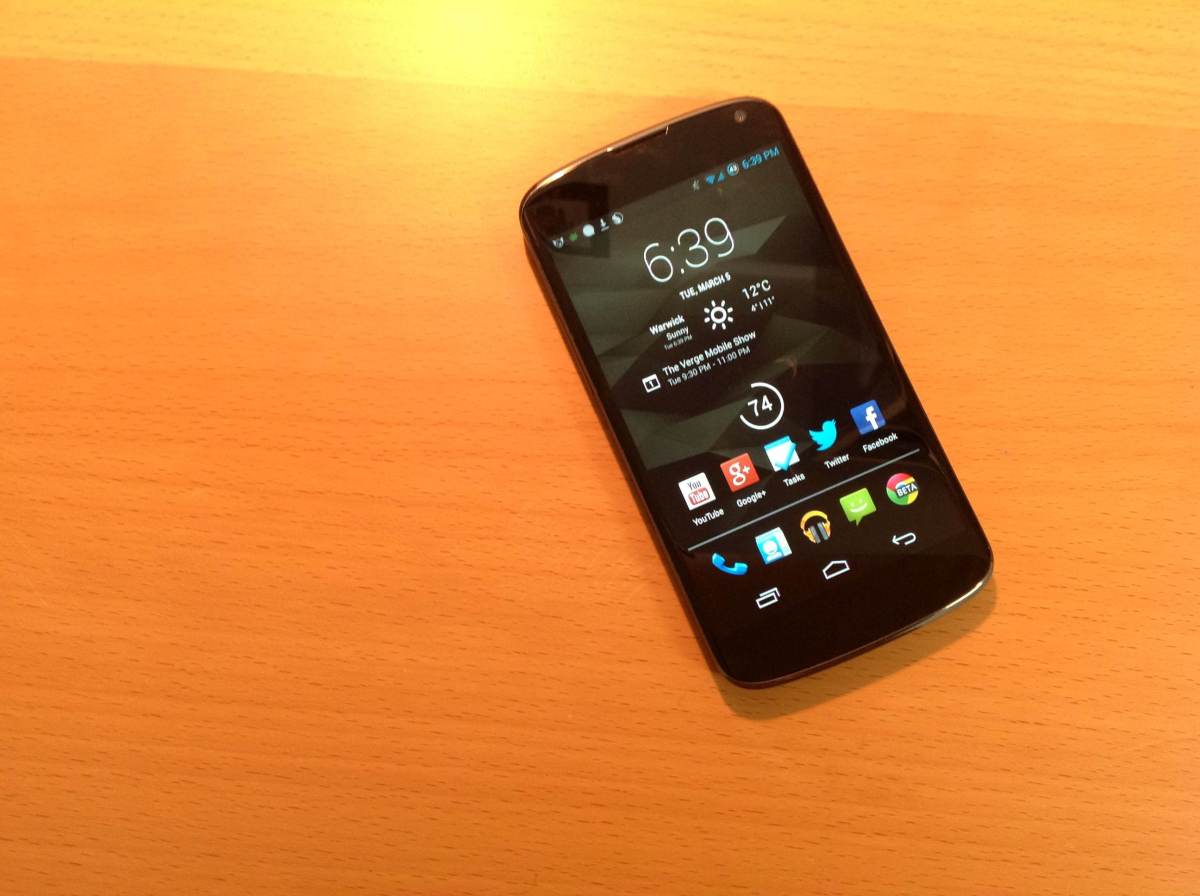
This phone is beautiful. There are no other words to describe it. It is right up there with the iPhone 5 and One X in terms of hardware design and build quality, which is a massive achievement considering the price point. The unadorned glass façade gently curves down to meet the plastic frame which, when flipped over, reveals a gently shimmering micro-etched glass back. Sure, it was a poor design choice in terms of durability, but it looks great. The front is graced with a small speaker grill and a front facing camera. It also features a hidden notification light centred on the bottom bezel – which is very clear and bright. It’s also RGB, meaning it can be programmed to be any colour with apps such as Light Flow. Aside from the volume rocker and power button, the only keys you’ll see here are on-screen, keeping with the pattern started by 2011’s Galaxy Nexus and continued throughout many other post-Ice Cream Sandwich devices and, while not without their critics, I love them. It’s simplicity done extremely well.

Nexus 4 Back

The screen is a 4.7” WXGA (1280 x 768) IPS affair, but some of it is taken up by software buttons. The screen is also up there with the best, using the same in-cell technology the iPhone 5 made a big deal about which, seeing as both panels come from LG, makes perfect sense. The colours and vibrancy are great, although still trail behind AMOLED in certain aspects. The Nexus 4 feels solid in the hand, but also feels very slippery due to the glass back and curve, and I therefore highly recommend getting a case for it, no matter how difficult it is to cover up the beautiful exterior. Another slight problem is the chrome band surrounding the front. While it is done very well, it does have the tendency to scratch or dent. The buttons are made of the same material. They have a nice travel, and feel solid, but they are quite slippery – a recurring theme with the hardware on this phone. However, in spite of all of these flaws, this is easily one of the best designed Android phones ever.

Nexus 4 Base

Inside, the Nexus 4 sits perched upon the top of 2012’s internal hardware. It has a 1.5GHz quad-core Snapdragon S4 Pro with an Adreno 320 GPU, coupled with 2GB of RAM giving you a blazing fast phone, although the upcoming flagships like the HTC One and Galaxy S IV should easily eclipse it. Benchmark scores demonstrate this, although these should be taken with a pinch of salt, as our testing shows that the US variant of the Galaxy S III (with dual-core S4 chip) obtains a higher Quadrant score than the quad-core S4 Pro-powered Nexus 4, suggesting that this benchmark has not been properly optimised for Android 4.2 yet.

Benchmarks

Device Chipset Quadrant AnTuTu NenaMark2
LG Nexus 4 1.5GHz Snapdragon S4 Pro (Quad) 4694 17561 59.6 fps
Samsung Galaxy S III (US) 1.5GHz Snapdragon S4 (Dual) 5325 7373 48.7 fps
HTC One X+ 1.7GHz Tegra 3 (Quad) 7652 13546 57.0 fps
HTC One X (Intl.) 1.5GHz Tegra 3 (Quad) 4602 9795 54.7 fps
Asus Nexus 7 1.3GHz Tegra 3 (Quad) 3734 10426 55.3 fps

Software

This phone is running pure, unadulterated Android and is all the better for it. Untouched by manufactures, this allows the end user to experience and enjoy Android as Google intended, which is of course one of the major selling points of this phone. A positive knock-on effect of this is that it should receive timely updates to Android, currently on version 4.2.2. This is why the Galaxy Nexus remained a great phone throughout it’s lifespan – and why the Nexus 4 will be the same. It’s a safer choice than a Samsung or HTC phone, which may or may not be updated to the latest version of Android.

Nexus 4 Corner

Android 4.2 is the best version of Android yet, and it looks great on the hardware of the Nexus 4. I’m not going to do a full review of the software as it’s still the Jelly Bean that we know and love from I/O 2012, but I’ll go over a few of the new features, such as lock-screen widgets. Combined with the ever-growing number of third party apps that support this functionality, this is amazing. My favourite use case is to see my to do list and edit it all from my lock screen. This is joined by gesture typing (a Swype-esque keyboard), Photo Sphere (StreetView-esque 360 degree panoramas) and Miracast streaming to make the latest point upgrade of the dessert-flavoured OS.

Nexus 4 Camera

What does this all mean to you? Basically, you get a rock solid, lightning fast version of Android. This is easily on par with the iPhone, if not smoother thanks to Project Butter. It also blends in with all the apps that follow the Holo design guidelines (unlike the One X). I realise I must sound like a fanboy when I say this, but honestly it’s true. There are still places where Android lags behind iOS, but those places are few and far between. I’m genuinely excited to see what Android 5.0 will bring.

Camera, Battery and Radios

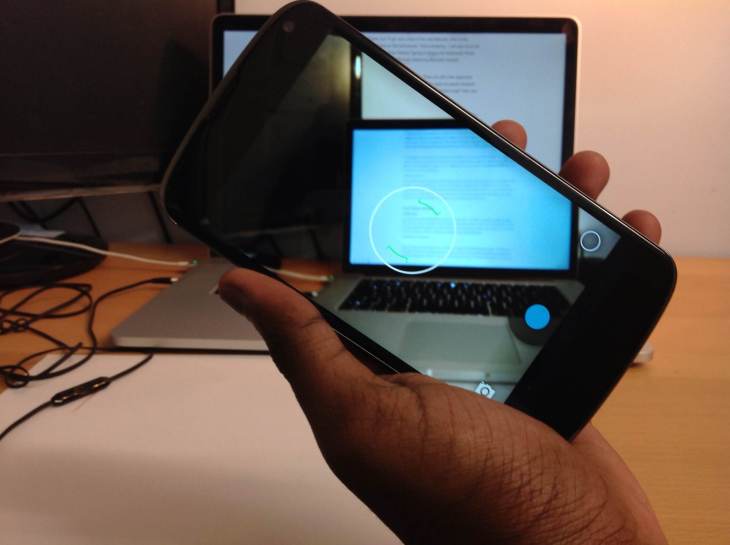
As many reviews have stated before, and more will state after, the Nexus 4 camera is simply average. Don’t get me wrong, it’s good, but not amazing. I would put it about on par with the iPhone 4S in terms of picture quality, and slightly worse than that for colour reproduction. Rather than telling you, it’s better for me to show you. There is a full gallery of sample shots on the way to be added to this review later.

Nexus 4 Sample Shot Can

Again, the same goes for battery life. It is average, and maybe even slightly below. The Nexus 4 lasts about 10 hours on a charge, but with screen on time fluctuating wildly depending on usage and the ROM. My highest is about 4.5 hours and the lowest is about 1.5 hours. Not great, but with a bit of careful usage here and there it will get you through the day. I’ll also update this review with screenshots of a few charge cycles. I’m not entirely sure why the battery life is so sub-par considering it is a non-LTE phone with a 2100mAh battery, but I assume that the internals or apps are draining it.

The radios in the Nexus have been very good, definitely better than the One X I reviewed last year. WiFi reception has been pretty good, reaching 3 bars out of 4 in my room. This is pretty good for a smartphone as my room has brick walls, and 3G reception has been pretty good too. One major thing that the phone has been bashed for is the lack of 4G LTE capability, but if you are in the UK then that shouldn’t be a problem until much later when 4G is widespread, unless you are an EE customer.

Conclusion

Nexus 4 Conclusion

The Nexus 4 is easily the best phone in its price bracket and, in most ways, it is definitely the best phone on the market. However, is it the phone that you should buy? The HTC One and Samsung Galaxy S IV are both lurking just days away, and I say if you are buying a phone to last 3 or 4 years, this probably isn’t the phone to buy due to the crack-prone glass back and lack of LTE. If you are buying a phone to last 1 year (or even 2), then this is your phone. The promise of prompt Android updates ably aided by the swift internals will keep you ticking by nicely. Sure, in 2 years it might not be the best-specced phone, but it will remain the yardstick for Android in 2013. Why? Because it’s a Nexus, and this is how Android phones should be done.


BlackBerry 10 launch liveblog: full-touch Z10 and QWERTY Q10 shipping this week in UK and Europe

Screenshot 2013-01-30 at 12.27.04

It’s been a long time coming, but today is the day that RIM steps into the future as they prepare to unveil their new – and heavily delayed – BlackBerry 10 platform and devices. Rumour has it that we will see two devices today – one with RIM’s iconic QWERTY keyboard and one with just touch input – and further leaks suggest that we could even see devices on store shelves within the next 24 hours. Whether or not this turns out to be the case, RIM’s New York launch event starts at 10am ET/3pm GMT, and we will be blogging it live on this very page. Join us then to find out what RIM’s been working on.

All times are in GMT
This event has now finished

14:58 Let’s go!

15:00 Things seem a bit late starting, but the live stream is available here.

15:01 The apps seem to be popping up already. Here’s evidence.

15:04 According to TechnoBuffalo, the Z10 is already in Phones4U. We’ll be hunting it down tomorrow.

15:06 Things are kicking off! They flashed up the already-announced software stuff and now a broadcasting guy is showing global launches.

15:08 Now they’re showing business people (including EE’s Olaf Swantee) talking about what they love about BB10.

15:09 What seems evident is that carriers and businessmen love BB10, but will consumers?

15:10 I love rhetoric questions.

15:10 Alec Saunders, VP of Developer Relations (and this guy) says there are no devs in Antarctica. I need to prove him wrong.

15:13 “Honk if you want BlackBerry 10!” says this guy.

15:13 Now there’s a guy who made a song called No Sleep ‘Til BlackBerry 10. I kid you not.

15:14 Now random guy is talking to CrackBerry Kevin, the guy who said he wouldn’t cut his hair until the launch.

15:15 THEY ARE CUTTING KEVIN’S PONYTAIL.

15:16 Here’s Thorsten Heins, sounding German.

15:18 “Innovation is at the heart of RIM. Now finally, here we are!” Thorsten gets applause.

15:19 They keep saying BlackBerry 10 is here, but they’re not actually doing anything.

15:20 Are you hyper-connected socially? BB10 is for you!

15:21 It is ‘built to keep you moving’.

15:23 We can confirm Thorsten did just say ‘internet of things’.

15:23 Thorsten’s thanking the QNX guys, Jim Balsillie and Mike Lazaridis.

15:26 RIM is killing the RIM name. RIM is now BlackBerry, making the BlackBerry. Finally they are making sense.

https://twitter.com/reckless/status/296640579809452032 https://twitter.com/jwherrman/status/296640722264797184

15:28 BlackBerry’s new stock symbols are BBRY and BB.

15:29 NEW PHONES. Z10 and Q10.

15:29 The Z10 has a 356ppi 1280 x 768 4.2″ screen with a textured surface for comfort.

15:31 The Q10 has a physical keyboard. That’s literally it.

15:32 It does, however, have a glass weave cover. Nobody knows what that is, but it sounds weavy.

15:34 Some guy called Vivek is showing off the Flow multitasking and Peek notifications while watching a video of a German car.

15:37 Vivek and Thorsten are making vacation jokes in the Hub (the one with the notifications).

15:38 BB10 can link contacts together automagically, just like every other platform in the world.

15:38 Thorsten is literally clapping louder than the entire audience.

15:40 The new prediction-heavy keyboard looks cool, and is modelled on the BB QWERTY.

15:41 The default email signature seems to be “Sent from my new BlackBerry Z10”. UGH. I WILL NOT READ YOUR EMAILS WITH THAT KIND OF ADVERNATURE.

15:43 Balance lets you have work and personal profiles. Thorsten’s talking about the boring business security stuff.

15:56 We’re back! WordPress decided to do some server maintenance. Here’s what we missed.

https://twitter.com/Xavdog/status/296646858732875776

15:56 And camera stuff, new third party apps (70k total) and Story Maker. STORIES.

15:58 The review embargo has been lifted. Here’s Joshua Topolsky’s.

16:02 Over 1k top apps are on BB10. Massive punch aimed at Microsoft.

16:03 There’s Rdio, SoundHound, EA, social stuff and other stuff, but no sign of Spotify. Dealbreaker for many.

https://twitter.com/jesusdiaz/status/296649675413520385

16:06 You can also get movies, TV and music from BlackBerry World.

16:07 Insert generically intensely soundtracked content advertising video here.

16:08 All four US carriers are getting these. Insert Thorsten clap.

16:09 The Z10 is available tomorrow in the UK in basically every store. I know what I’ll be doing tomorrow.

16:10 Chemistry, that is. Might find the phone after.

16:10 Another big announcement from Thorsten is impending!

16:11 “We’ve created a new positiion at BlackBerry. A Global Creative Director!

16:12 It’s Alicia Keys.

https://twitter.com/LaughingStoic/status/296652154997989376

16:15 Thorsten Heins is officially freakishly tall. Either that or all his employees are diminutive.

16:16 Alicia wants to “bridge the gap between the work phone and the play phone”.

16:17 Her job is to persuade Neil Gaiman to use BB10. There’s a video on it.

https://twitter.com/MikeIsaac/status/296653015505592321

16:20 It seems Alicia is starting in the office on Monday. Nice few days off.

16:20 Thorsten’s wrapping things up, so I will too. Thanks for joining us!

16:21 The press get a Q&A session, but I get to go and eat some crisps now. I’ll be getting some hands-on time tomorrow.

16:21 See you next time!

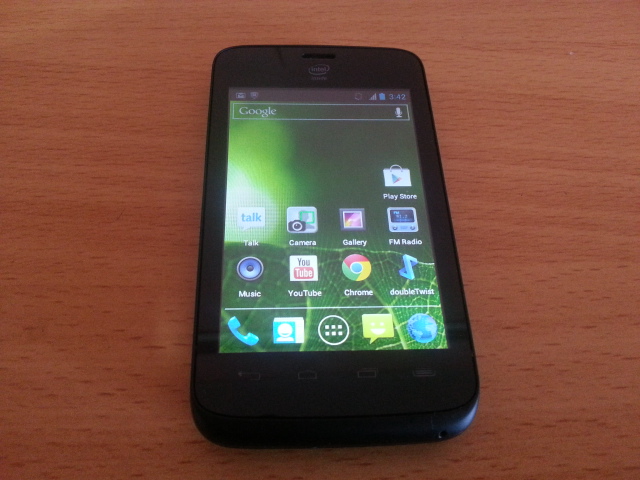
Intel and Safaricom announce Yolo, a Lexington-powered phone for Kenya

Intel Yolo Lexington

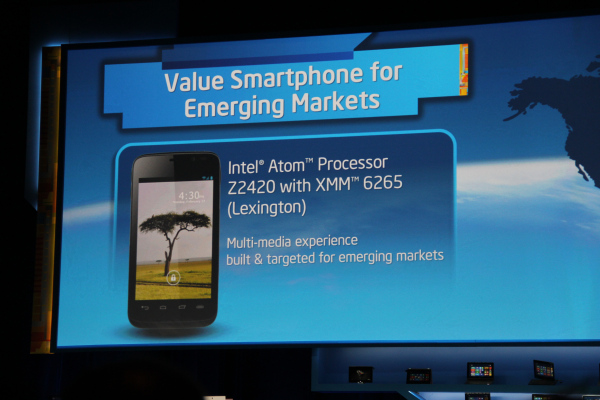
Intel’s march into the mobile market hasn’t been as successful as they would have desired, with devices powered by the Medfield family of Atom chips such as the XOLO X900 and Orange San Diego struggling for traction, although things began to look up with the release and heavy marketing of Motorola’s RAZR i late last year. With its second wave of phone chips, codenamed Lexington, the company has decided to target emerging markets, and the first Lexington phone has now been announced in conjunction with Safaricom, one of Kenya’s largest carriers.

Intel Yolo

The Yolo (yep, YOLO) is essentially a consumer version of the Intel Smartphone Reference Design shown off at CES, and its Atom Z2420 chip clocks in at 1.2GHz, which Engadget notes makes the phone feel like 2009, and its 5MP rear camera is capable of 1080p video and a 7 shot-per-second burst mode. The Yolo will also have a 3.5″ touchscreen of as-yet-unknown resolution, and an HSPA+ modem will be responsible for connectivity. The Yolo will be available in Safaricom stores with 500MB of data for Kshs. 10,999 (£79.57) and will almost certainly make its way to Europe with alternative branding later this year.

Update: @tazersky tipped us of to Techweez’s review of the Yolo, complete with images and more spec information.

Via TechCrunch
Source Intel Newsroom
Image Credit Techweez

The Verge: Nokia to release ‘true’ PureView EOS Windows Phone in 2013 with aluminium body

The Verge’s Tom Warren, a reliable writer with regard to Microsoft news, reported that Nokia will be releasing the first ‘true’ PureView Windows Phone handset late in 2013. The device, codenamed EOS, will feature a sensor closer to that which appeared on the Nokia 808 PureView which was released last year. As well as this, it is reported that the device will signal the start of a new design cycle for the Lumia range. The device will be made of aluminium and will have squared edges, contrasting with the rounded polycarbonate body found in the current Lumia range.

The device is believed to be in the pipeline for AT&T in the US, and is expected to be released alongside another device (codenamed Catwalk) which will also have an aluminium body. It is clear that Nokia is moving away from the polycarbonate which they have used in their previous Windows Phone handsets. This change means that they will be in a much better position to compete with phones such as the iPhone 5 when it comes to size and weight, something that they have been unable to do thus far with the Lumia range, however this is in no way Nokia’s first phone of aluminium construction. The Nokia N8, the precursor to the aforementioned 808 PureView, was constructed out of the lightweight metal and was indeed available in a number of colours. With MWC coming up in a few weeks, we can expect to see more information coming out of Finland with regard to these handsets and Nokia’s upcoming Windows RT tablet.

Source The Verge

Delayed Samsung Ativ Odyssey Windows Phone will hit Verizon shelves on January 24th

Samsung Ativ Odyssey Verizon Windows Phone

Microsoft’s Windows Phone 8 launch event was headlined by the appearance of Jessica Alba, but otherwise very little unknown information surfaced about the operating system or the devices it would appear upon. One smidgen of news that did emerge, however, was that a Samsung device, depicted by a lonely silhouette and named the Ativ Odyssey, was in the pipeline for a December release on Verizon in the US. Of course December came and went without a release, but CES gave Samsung the opportunity to show the 4″ Windows Phone 8 device to the world. Now, a press release has stated that the phone will be available sooner rather than later, with stores set to receive the Ativ Odyssey and Valentine’s Day editions of the Nokia Lumia 822 and Motorola Droid Razr M tomorrow (January 24th).

The Odyssey joins the Lumia 822 and HTC 8X in Verizon’s lineup of LTE Windows Phones, and its microSD slot and 2100mAh battery should win it some fans, although the 800 x 480 screen resolution and 5MP camera show that it is pitched towards the lower end of the market. As with almost all other Windows Phone 8 devices, the package comes powered by a 1.5GHz dual-core Qualcomm Snapdragon S4 chip accompanied by 1GB of RAM, and it will be available for $49.99 with a new 2 year contract, while whispers of a European launch remain unconfirmed but not impossible.

Via Engadget
Source Verizon Wireless

Mozilla shows off developer phones for Firefox OS

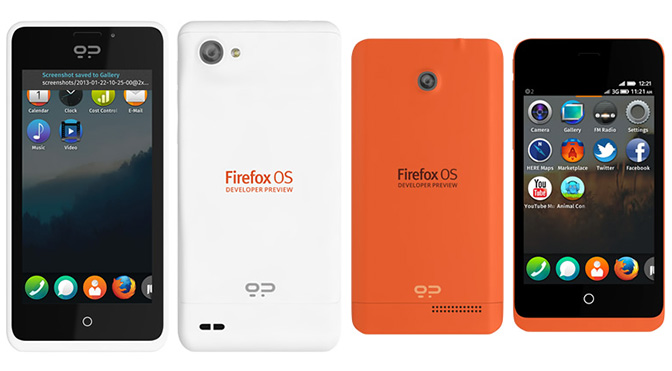
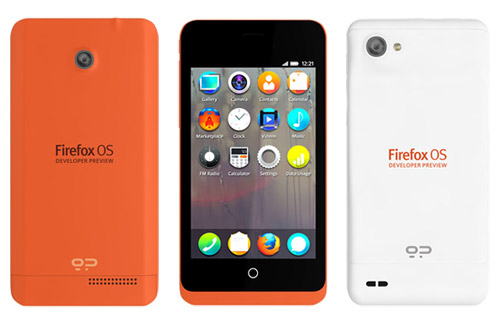
firefoxphone Mozilla has just announced that they’ve got two “Developer Preview Phones” in the works which will run on their own Firefox OS. Both are made by relatively unknown Spanish company Geeksphone. The orange phone above is known as the Keon, and has 3.5-inch touchscreen and has a 3-megapixel camera on the back. It comes with 512MB of RAM and 4GB of internal storage, and runs one of Qualcomm’s 1Ghz Snapdragon CPUs. The white model is called the Peak, and has higher specs than the Keon, with a 4.3-inch screen, 1.2Ghz dual-core Snapdragon S4 CPU and an 8-megapixel camera, though it has the same storage and RAM. It runs on a 1800mAh battery, slightly larger than the Keon’s 1580mAh cell.

Mozilla didn’t mention anything to do with price or  a specific release date, but Digixav understands that the Keon will start shipping next month.

These handsets clearly aren’t going to set the world alight, and it seems as though Firefox might be targeting developing markets with cheaper smartphones. Software-wise, from a purely visual perspective the home screen looks very similar to the iOS one, simply with circular icons instead of Apple’s square ones. We have to say that it is a big disappointment that Mozilla couldn’t have found a fresh or innovative design rather than slightly altering one which is five years old.

Firefox OS works very differently to current mobile operating systems. The processors might seem tiny compared to the quad-core beasts powering the latest phones, but Mozilla have tried to make it so the phones don’t need huge processors to run smoothly. The big thing that sets it apart from rivals, however, is that Firefox OS doesn’t do native apps. What might look like native apps on the phone are actually website bookmarks. This means it can all be written in HTML5, which could be a big boost for some developers. This is a certainly a huge step Mozilla have taken, and it will be interesting to see how the consumer market responds. Mozilla reckons that we’re not doing apps right at present, and we could lose the wonderful open web we currently take for granted.

Here at Digixav we’ll certainly be watching closely to see whether Firefox OS can make a significant impact on the smartphone audience. With an Ubuntu mobile operating system on the way, it will be very interesting to see whether this new breed of open source software can have the desired impact on the iOS and Android dominated market.

Via Wired

Japanese carrier NTT DoCoMo announces Pro version of LG Optimus G with 5″ 1080p display

LG Optimus G Pro NTT DoCoMo

In unveiling its DoCoMo NEXT line of smartphones and tablets for 2013, Japanese carrier NTT DoCoMo has confirmed the impending release of an enlarged version of the LG Optimus G, the phone that served as the basis for the Nexus 4. The Optimus G Pro trades a 4.7″ 1280 x 720 panel for one of 1920 x 1080 over 5 inches, but that appears to be the only major difference, as both Pro and ‘Amateur’ models feature quad-core Qualcomm Snapdragon S4 Pro chips powering a skinned version of Android 4.1. The 3000mAh battery is the largest in DoCoMo’s new smartphone line, and a 13.2MP BSI CMOS sensor can be found on the rear. Along with the usual array of Japan-specific features such as One-Seg TV broadcasting, the Optimus G Pro will also support LTE, NFC and WiFi tethering for up to 8 devices, while a microSD slot will allow for up to 64GB of expansion. The phone is said to be hitting NTT DoCoMo in April although, as with the Sony Xperia Tablet Z, it remains unlikely that this phone will ever be seen beyond Japanese shores.

NTT DoCoMo 2013 Spring Collection

Via Android Police
Source NTT DoCoMo

Nvidia unveils Tegra 4 chip and Project Shield handheld console at CES conference

Screen Shot 2013-01-07 at 12.49.13

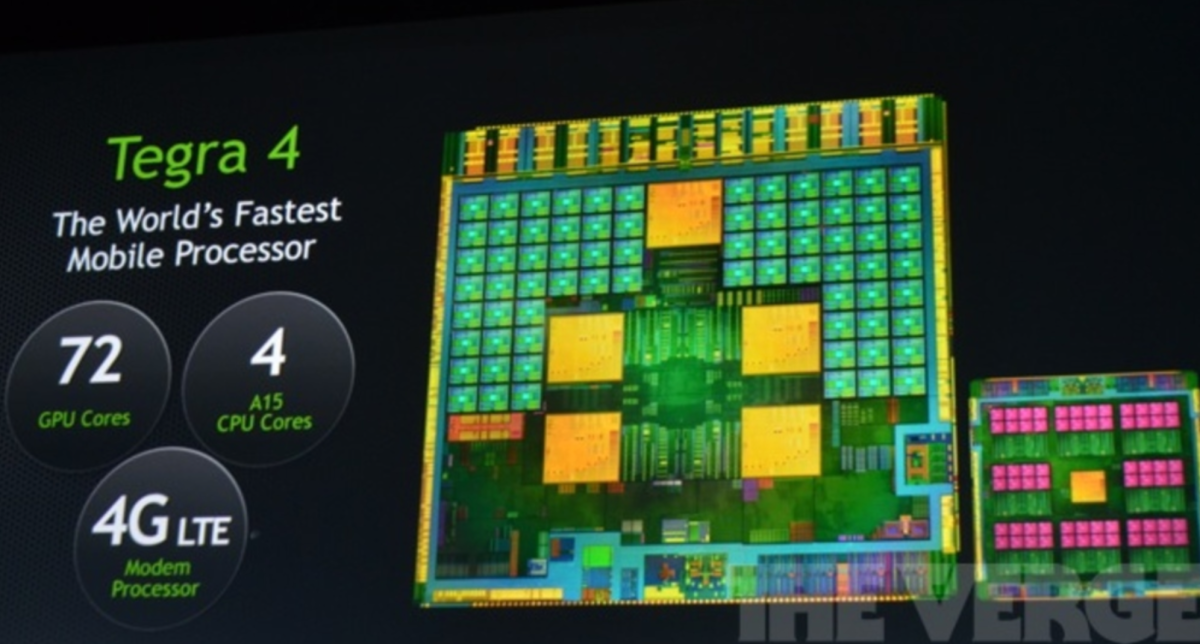
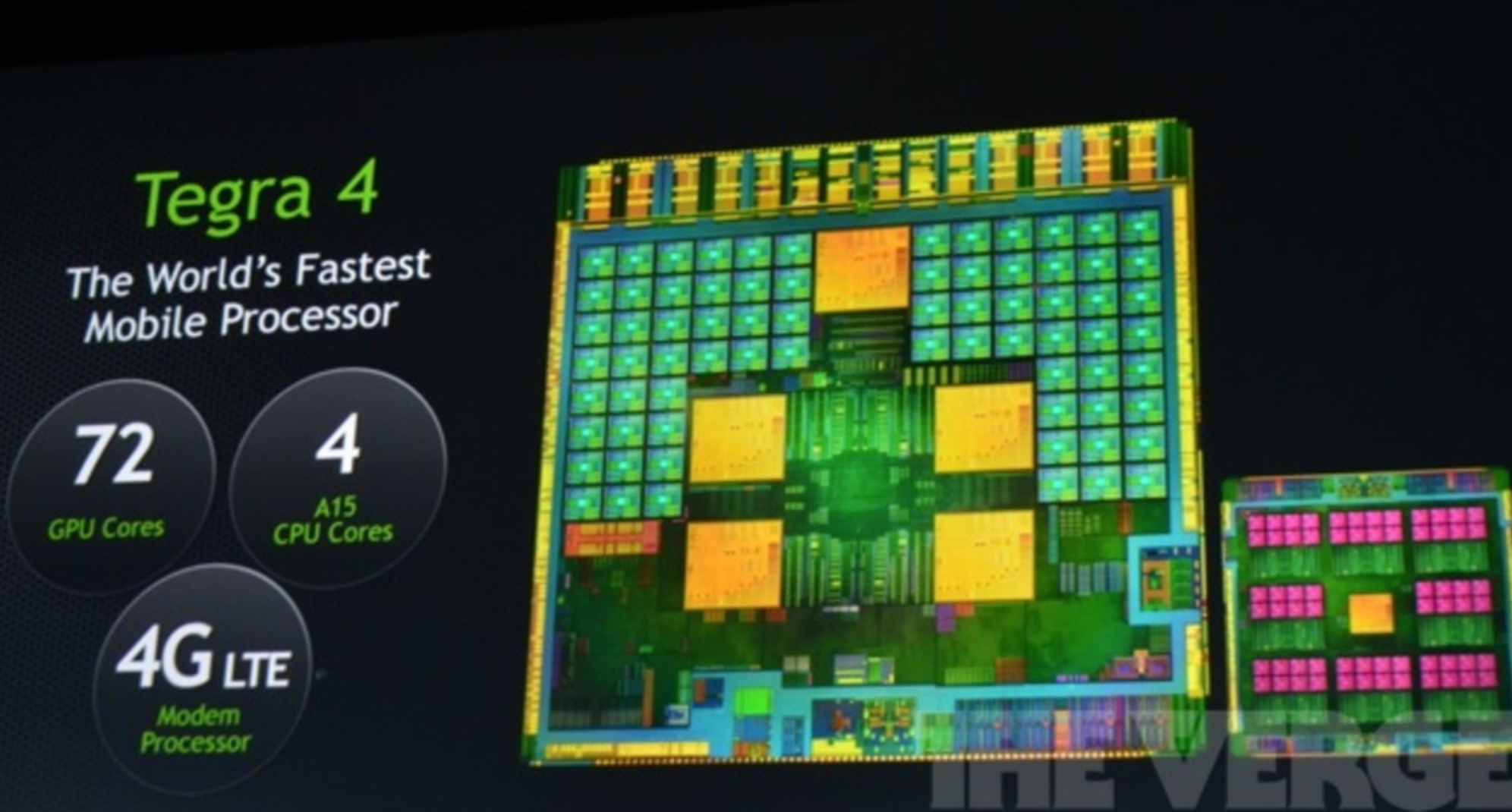
It’s the first day of CES proper today, and the news has started to flood in. Nvidia held an interesting press conference today to announce a few things. There’s no doubt that the most anticipated (and most important) announcement of the day was the Tegra 4 – Nvidia’s new flagship chip to ‘rule them all’. That is until Qualcomm and Samsung show off their work. The new chip packs 72 GPU CUDA cores, and is produced on a 28nm manufacturing process which is a step up from the 40nm of the Tegra 3. This means that even though the chip packs more power, it’ll take less of a hit on the battery life. It uses a new quad core, Cortex-A15 based architecture as well. One notable omission is the lack of integrated LTE – while it does ship with an external modem, that both takes a hit on battery life and reduces space inside of the phone. It’s interesting to see whether this impacts Tegra 4 adoption, as many phones which used a Tegra processor internationally had to use a Qualcomm processor in the US so as to keep LTE.

Screen Shot 2013-01-07 at 12.44.14

The other thing that Nvidia announced was a new handheld gaming system called Project Shield. This came to me as a surprise, but its very very interesting. It features a 5″ 720p display, a Tegra 4 chip and an Xbox-esque controller portion. It is running stock android (i.e good) and has the ability to stream games from your Steam library from your computer to the device, where you can play them. It’ll be interesting to see whether this catches on or flops when it becomes available in Q2 2013

Microsoft confirms features and release plans for Windows Phone 7.8

In a blog entry posted today, Windows Phone corporate vice president Terry Myerson confirmed Microsoft’s plans for Windows Phone 7.8, the update that the company has remained quiet about since its announcement at the Windows Phone 8 event in June. Serving to sweeten the blow for existing Windows Phone 7.x device owners that are unable to update their devices to the latest version of the operating system, 7.8 will bring new Start screen options including resizeable tiles and 20 theme colours, and users can also opt to have new password options and the daily Bing picture as their lock screen wallpaper. While developers are unlikely to target 7.x for app releases due to SDK changes for 8, Myerson promises that Angry Birds Space and Angry Birds Star Wars will soon join Draw Something and Words With Friends in the expanding Windows Phone Store for 7.x. The update is currently said to be in testing with OEM and carrier partners, and Microsoft hope for a smooth rollout of the update in early 2013.

Source Windows Phone Blog